> ## Documentation Index
> Fetch the complete documentation index at: https://docs.purna.ai/llms.txt
> Use this file to discover all available pages before exploring further.
# Plan Mode
> Clarify complex requests, approve an execution plan, and follow every step before reviewing the generated deliverables.
Plan Mode adds a review and approval layer before Purna begins a complex task. Instead of moving directly from your request to execution, Purna clarifies the scope, creates a detailed plan, and waits for your approval.
Use Plan Mode when a task has multiple steps, requires specialized tools or compute, or needs clearly defined outputs and validation criteria.
## 1. Submit and clarify your request
Start with the scientific or technical outcome you want to achieve. For example:
```text theme={null}
Explain the mechanism of semaglutide, predict the structures of native GLP-2 and semaglutide, and model the docking of GLP-2 with GLP-2R.
```
If the request leaves important choices open, Purna asks follow-up questions before creating the plan. These questions establish the task scope and prevent the execution agent from making avoidable assumptions.
Include relevant files, preferred methods, required formats, and validation expectations when you already know them.
## 2. Review the proposed plan
Purna translates the clarified request into an executable roadmap. The plan separates the work into explicit sections so you can review both the intended result and how Purna proposes to reach it.
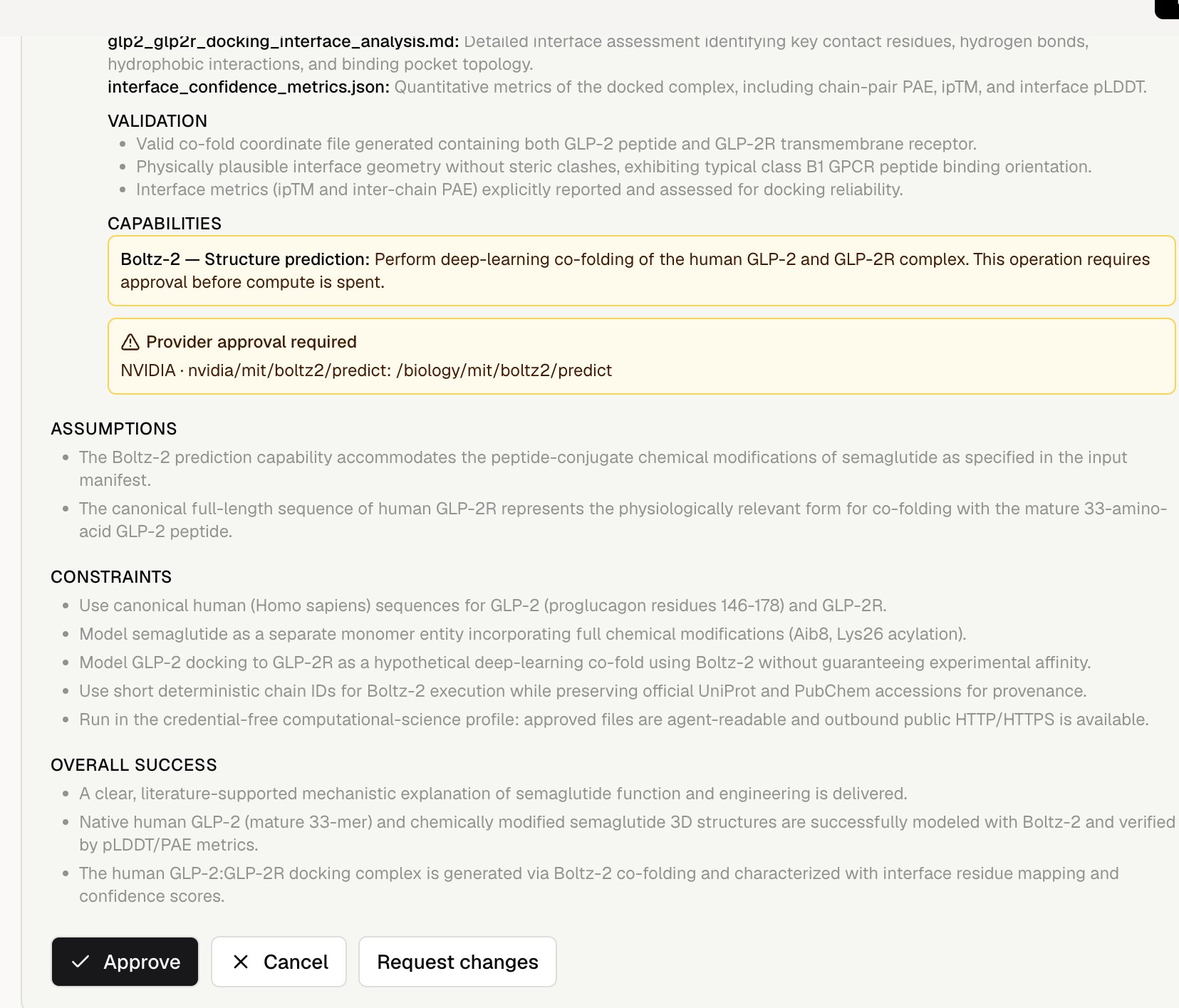
| Plan section | What it defines |
| ------------------- | ------------------------------------------------------------------------------------- |
| **Approach** | The ordered research, analysis, modeling, or generation steps |
| **Deliverables** | The files, reports, structures, figures, or other outputs Purna will create |
| **Validation** | The checks used to evaluate whether outputs are complete and scientifically plausible |
| **Capabilities** | Specialized tools, data providers, models, or compute services required by the task |
| **Assumptions** | Interpretations Purna will use unless you specify otherwise |
| **Constraints** | Scope limits, required inputs, methods, provenance rules, and operating boundaries |
| **Overall success** | The conditions that must be satisfied for the task to be considered complete |
Some capabilities use external providers or consume additional compute. When approval is required, the plan identifies the provider and operation before any compute is spent.
## 3. Approve or revise the plan
Choose the next action after reviewing the roadmap:
* Click **Approve** to lock the current plan version and begin execution.
* Click **Request changes** to revise the scope or approach before work begins.
* Click **Cancel** to stop the task.
After approval, the locked plan appears in **Approved roadmap** on the right panel. Purna passes that approved version to the appropriate execution or research agent, creating a clear boundary between planning and execution.
Plan Mode does not automatically turn every task into a Deep Research run. It can prepare many kinds of multi-step work, including literature research, data analysis, code execution, molecular modeling, and artifact generation. For systematic literature reviews, see [Deep Research](/chat-experiences/deep-research).
## 4. Follow the execution
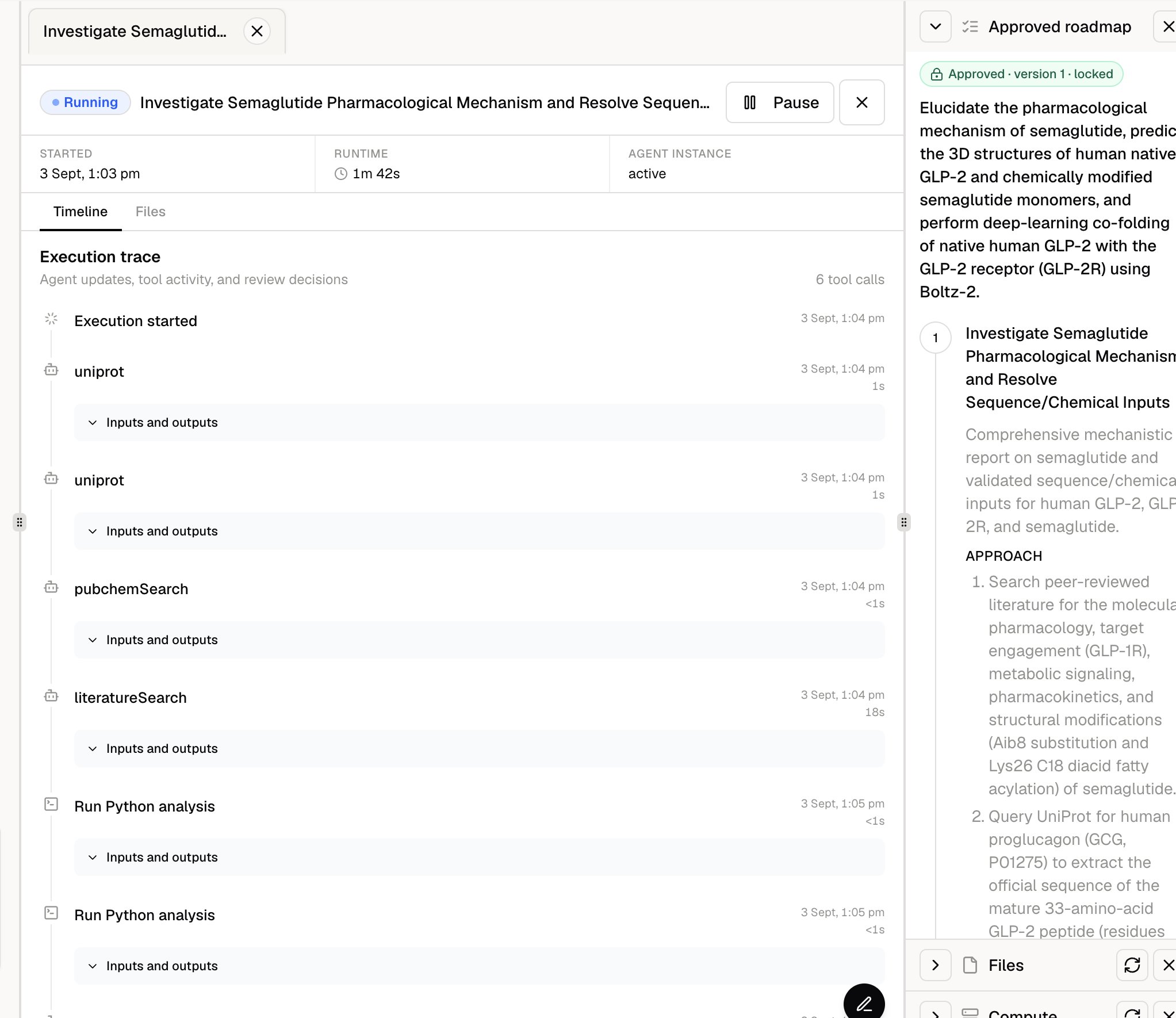
You can open the execution timeline in either of two ways: click **View reasoning** on the task card in the chat, or open **Compute** in the right panel and select the running task. Both routes open the execution trace, where you can follow the approved roadmap alongside the work being performed.
The execution layer records:
* The active agent instance and task status
* A chronological timeline of execution steps
* Data sources, tools, scripts, and specialized providers used
* Inputs, outputs, and tool results available for inspection
* Pauses, approvals, review decisions, and failures that require attention
* Files created while the task runs
You can continue working elsewhere in Purna while the task runs. Return through **View reasoning** or **Compute** whenever you want to check progress or inspect a step in more detail.
## 5. Review generated files
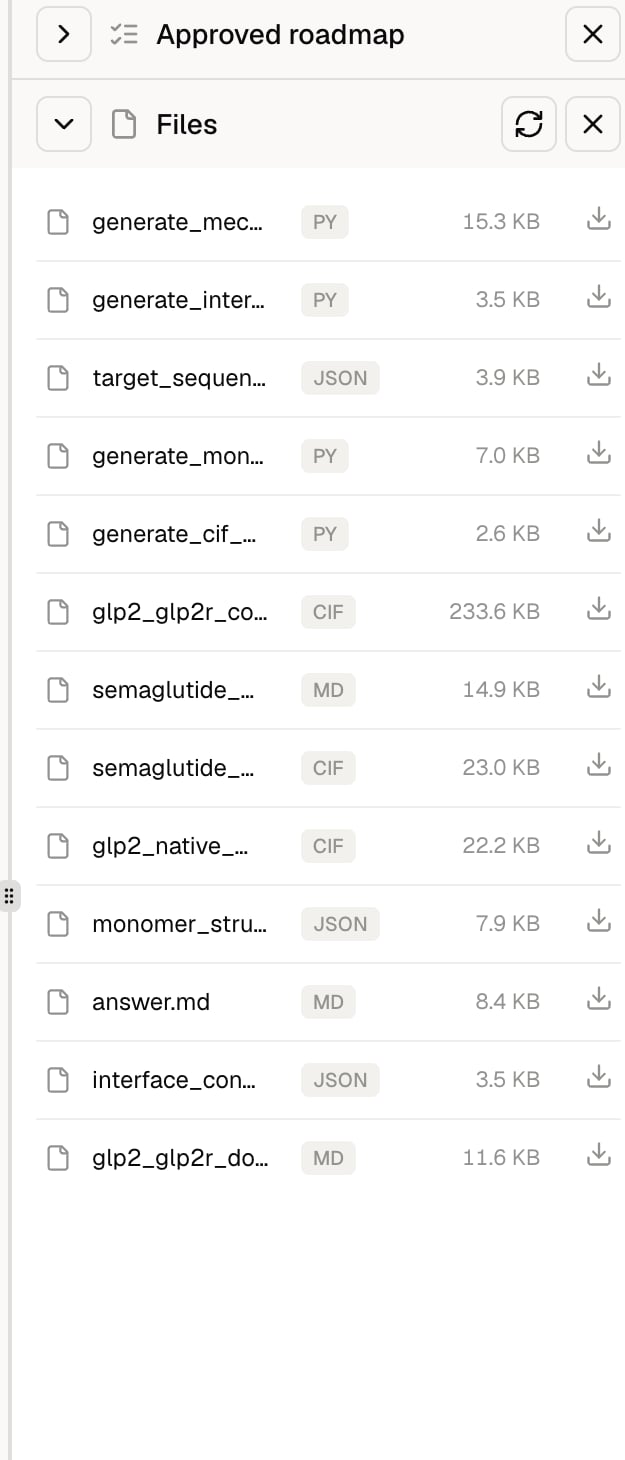
When the task produces an artifact, it appears in the session's **Files** section. The exact file types depend on your request. A computational biology workflow may generate:
* CIF structural files (`.cif`)
* Structured metadata and metrics (`.json`)
* Reports and explanations (`.md`)
* Reproducible analysis or generation scripts (`.py`)
Purna also creates `answer.md` when the workflow includes a final written summary. It consolidates the key findings and points you to relevant information across the other deliverables.
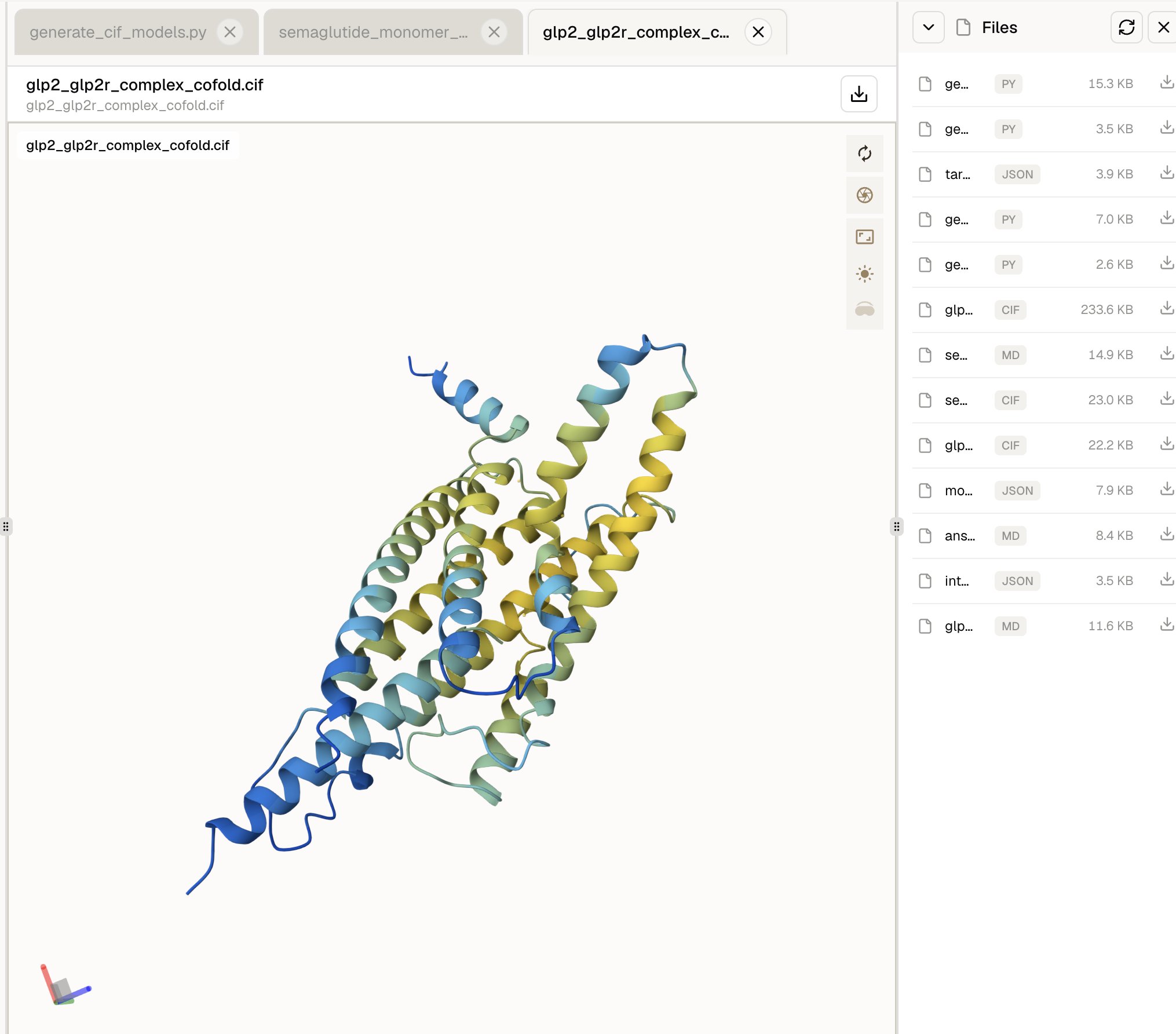
Supported scientific outputs can be opened directly in Purna. For example, you can inspect a generated CIF structure in the built-in molecular viewer without leaving the session.
## 6. Continue with follow-up requests
After the task finishes, you can continue working in the same session. Ask a related question, request a revision, add another validation step, or build a new output from the completed work.
Purna can use the existing session context, including:
* Your original request and clarifications
* The approved plan and earlier decisions
* The execution timeline and tool results
* `answer.md` and the other generated files
For example, you can ask Purna to compare an additional structure, rerun an analysis with different constraints, revise the final report, or create a visualization from the generated data. You do not need to upload the same files or restate the entire task.
If a follow-up substantially changes the scope or requires new tools or compute, Purna may prepare another plan for your approval before continuing.
## Watch Plan Mode in action
See how Plan Mode clarifies, plans, and runs a multi-omics data analysis task.
 Some capabilities use external providers or consume additional compute. When approval is required, the plan identifies the provider and operation before any compute is spent.
## 3. Approve or revise the plan
Choose the next action after reviewing the roadmap:
* Click **Approve** to lock the current plan version and begin execution.
* Click **Request changes** to revise the scope or approach before work begins.
* Click **Cancel** to stop the task.
After approval, the locked plan appears in **Approved roadmap** on the right panel. Purna passes that approved version to the appropriate execution or research agent, creating a clear boundary between planning and execution.
Some capabilities use external providers or consume additional compute. When approval is required, the plan identifies the provider and operation before any compute is spent.
## 3. Approve or revise the plan
Choose the next action after reviewing the roadmap:
* Click **Approve** to lock the current plan version and begin execution.
* Click **Request changes** to revise the scope or approach before work begins.
* Click **Cancel** to stop the task.
After approval, the locked plan appears in **Approved roadmap** on the right panel. Purna passes that approved version to the appropriate execution or research agent, creating a clear boundary between planning and execution.
 You can continue working elsewhere in Purna while the task runs. Return through **View reasoning** or **Compute** whenever you want to check progress or inspect a step in more detail.
## 5. Review generated files
When the task produces an artifact, it appears in the session's **Files** section. The exact file types depend on your request. A computational biology workflow may generate:
* CIF structural files (`.cif`)
* Structured metadata and metrics (`.json`)
* Reports and explanations (`.md`)
* Reproducible analysis or generation scripts (`.py`)
Purna also creates `answer.md` when the workflow includes a final written summary. It consolidates the key findings and points you to relevant information across the other deliverables.
You can continue working elsewhere in Purna while the task runs. Return through **View reasoning** or **Compute** whenever you want to check progress or inspect a step in more detail.
## 5. Review generated files
When the task produces an artifact, it appears in the session's **Files** section. The exact file types depend on your request. A computational biology workflow may generate:
* CIF structural files (`.cif`)
* Structured metadata and metrics (`.json`)
* Reports and explanations (`.md`)
* Reproducible analysis or generation scripts (`.py`)
Purna also creates `answer.md` when the workflow includes a final written summary. It consolidates the key findings and points you to relevant information across the other deliverables.
 Supported scientific outputs can be opened directly in Purna. For example, you can inspect a generated CIF structure in the built-in molecular viewer without leaving the session.
 ## 6. Continue with follow-up requests
After the task finishes, you can continue working in the same session. Ask a related question, request a revision, add another validation step, or build a new output from the completed work.
Purna can use the existing session context, including:
* Your original request and clarifications
* The approved plan and earlier decisions
* The execution timeline and tool results
* `answer.md` and the other generated files
For example, you can ask Purna to compare an additional structure, rerun an analysis with different constraints, revise the final report, or create a visualization from the generated data. You do not need to upload the same files or restate the entire task.
If a follow-up substantially changes the scope or requires new tools or compute, Purna may prepare another plan for your approval before continuing.
## Watch Plan Mode in action
See how Plan Mode clarifies, plans, and runs a multi-omics data analysis task.
## 6. Continue with follow-up requests
After the task finishes, you can continue working in the same session. Ask a related question, request a revision, add another validation step, or build a new output from the completed work.
Purna can use the existing session context, including:
* Your original request and clarifications
* The approved plan and earlier decisions
* The execution timeline and tool results
* `answer.md` and the other generated files
For example, you can ask Purna to compare an additional structure, rerun an analysis with different constraints, revise the final report, or create a visualization from the generated data. You do not need to upload the same files or restate the entire task.
If a follow-up substantially changes the scope or requires new tools or compute, Purna may prepare another plan for your approval before continuing.
## Watch Plan Mode in action
See how Plan Mode clarifies, plans, and runs a multi-omics data analysis task.