> ## Documentation Index
> Fetch the complete documentation index at: https://docs.purna.ai/llms.txt
> Use this file to discover all available pages before exploring further.
# Protein Embeddings & Mutation Likelihoods
> Run ESM-2 and AbLang-2 on your protein or antibody sequences to produce embeddings and per-position mutation likelihoods — directly from the chat.
MIP can run two families of protein language models on your sequences, directly from chat:
* **ESM-2** — for **generic proteins**. Use it for embeddings or per-position mutation likelihoods on enzymes, receptors, scaffolds, or any non-antibody protein.
* **AbLang-2** — for **paired antibodies**. Use it on heavy + light chain pairs for antibody-aware embeddings or per-position mutation likelihoods that reflect natural antibody repertoires.
Both capabilities return a live, inline result card in chat, store the full numerical output as a downloadable dataset, and bill on actual compute time.
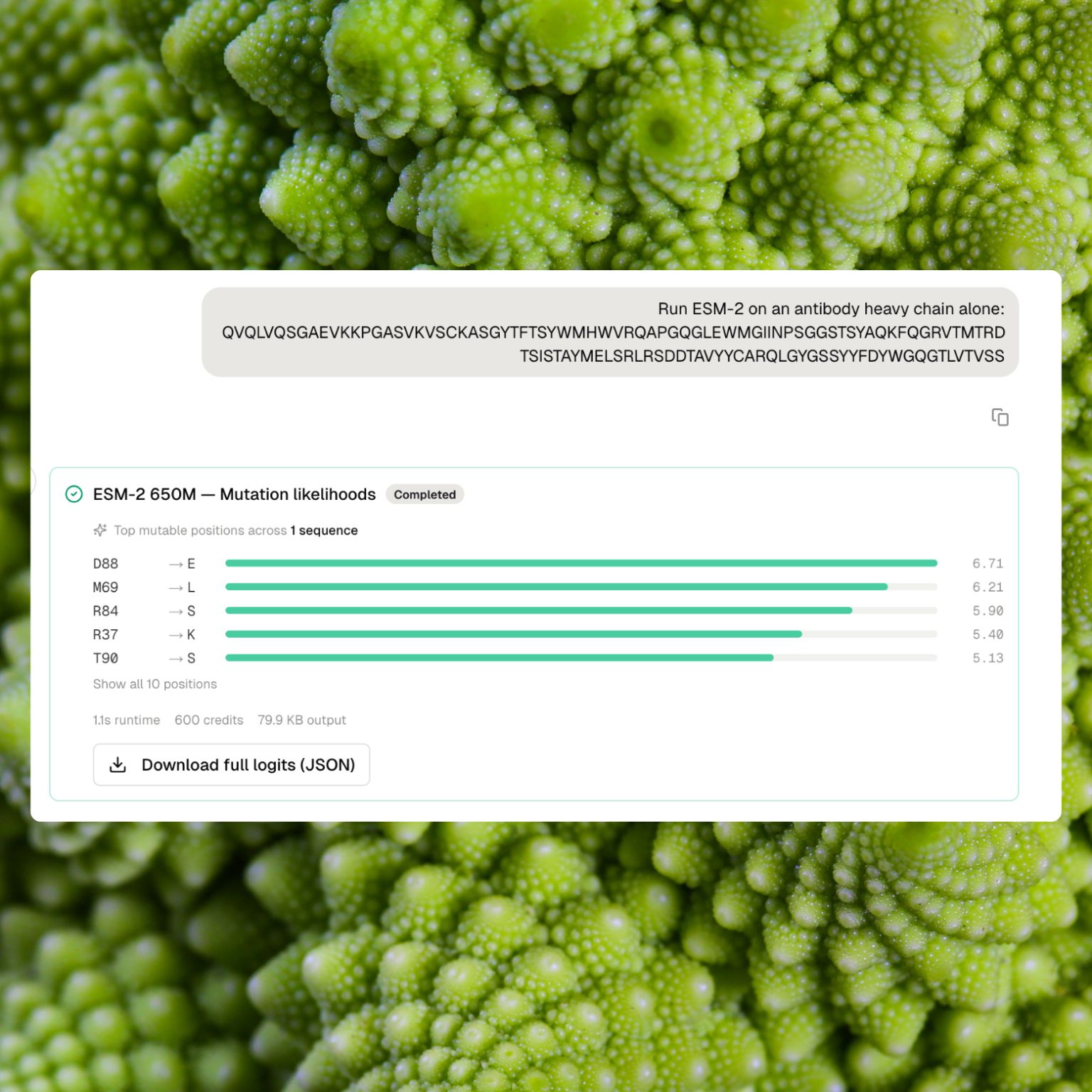
## What each capability does
### Embeddings
An embedding is a fixed-length vector that represents a full protein sequence. Two sequences with similar embeddings are treated as similar by the underlying model, typically reflecting similar fold, family, or function.
Use embeddings when you want to:
* **Cluster** a set of sequences by similarity
* **Compare** two or more proteins numerically
* **Search** a library for sequences similar to a reference
* Build **features for downstream ML** (activity prediction, property prediction)
You submit a batch of sequences, and the card returns a compact summary of how many were encoded and the vector dimensionality. The full numerical embeddings are saved as a downloadable JSON dataset so you can load them into a notebook, a clustering pipeline, or your own models.
### Mutation likelihoods
A mutation likelihood is a per-position score for every possible amino acid substitution at every residue. High scores at a position mean the model finds multiple alternatives plausible, which is often a signal of an evolvable, tolerant, or flexible site. Low scores mean the model strongly prefers the natural residue.
Use mutation likelihoods when you want to:
* Identify **candidate sites for mutagenesis** or affinity maturation
* Flag **unusual residues** in a sequence
* Rank substitutions at a known hotspot
* Get a **starting point for protein engineering**, before committing to wet-lab rounds
The result card shows the top mutable positions with their highest-likelihood substitutions in a compact list. The full per-position × 20-amino-acid likelihood matrix is saved as a downloadable dataset for deeper analysis.
## When to use ESM-2 vs AbLang-2
| You are working with | Use |
| -------------------------------------------------------------------- | --------------------------------------------- |
| Enzymes, receptors, scaffold proteins, generic non-antibody proteins | **ESM-2** |
| A paired antibody (heavy + light chain) | **AbLang-2** |
| Only a heavy chain, and you want an antibody-aware signal | ESM-2 is acceptable; AbLang-2 requires a pair |
| A large protein (up to 2,048 residues) | **ESM-2** |
| Multiple antibodies for a comparative embedding run | **AbLang-2** |
AbLang-2 is trained on paired antibody repertoires, so its likelihoods and embeddings reflect the statistics of real antibody sequences — CDR variability, framework conservation, and the pairing between heavy and light chains. ESM-2 is a general-protein model: broader coverage, no antibody-specific bias.
For antibodies, start with AbLang-2 for repertoire-aware signal. For everything else, start with ESM-2.
## Asking for a run
You can trigger either capability with a natural-language prompt. A few examples:
**ESM-2 embeddings**
* "Compute ESM-2 embeddings for this sequence: MKWV..."
* "Encode these 5 protein sequences with ESM-2 so I can cluster them."
**ESM-2 mutation likelihoods**
* "Give me per-position mutation likelihoods for this enzyme using ESM-2."
* "Run ESM-2 mutation scoring on this protein and show me the top mutable sites."
**AbLang-2 embeddings**
* "Encode these heavy/light chain pairs with AbLang-2."
* "Give me AbLang-2 embeddings for this antibody pair."
**AbLang-2 mutation likelihoods**
* "Run AbLang-2 mutation likelihoods on this paired antibody."
* "Show me the top mutable CDR positions for this antibody pair."
MIP validates the input, submits the job, and shows a live result card in the chat. You do not need to wait or refresh — the card updates itself as the job moves from queued to running to completed.
## Input formats
### ESM-2
| Field | Requirement |
| ------------- | ------------------------------------------------------------------------ |
| Items per run | 1 to 8 sequences |
| Length | 1 to 2,048 residues per sequence |
| Alphabet | Extended IUPAC amino acids and `-` for gaps (ACDEFGHIKLMNPQRSTVWYBJOUXZ) |
Paste sequences directly in the message, or attach a FASTA file.
### AbLang-2
| Field | Requirement |
| ------------- | ------------------------------------------------------ |
| Items per run | 1 to 32 paired antibodies |
| Length | 1 to 1,024 residues per chain |
| Alphabet | Standard 20 amino acids |
| Pairing | Each item must include both `heavy` and `light` chains |
Provide the heavy and light chain for each antibody. MIP uppercases sequences and strips whitespace automatically.
## The result card
When you submit, an inline card appears in the chat. It updates in place without a page refresh.
**While running:** a compact status card shows the model, the action, and a spinner. You can continue the chat — the card tracks its own job.
**When complete:**
* **Embeddings runs** show the number of sequences encoded and the vector dimensionality (for example, `3 × 1280 dims` for ESM-2 or `2 × 480 dims` for AbLang-2), plus a one-line hint on common uses.
* **Mutation-likelihood runs** show a ranked list of the top mutable positions with their highest-likelihood substitutions and scores. Positions are labeled with the observed residue and a clear arrow to the predicted alternative (for example, `Q127 → E (3.02)`). The list starts with the top 5 and expands on request.
**On failure:** the card shows the failure reason (invalid input, provider error, out of credits) and the run is not billed for the failed attempt.
## Downloading the full output
Both capabilities save their full numerical output as a downloadable dataset, accessible from:
* The result card's **Download** action
* The [Files](/guides/files) view, under your datasets
Embedding runs save the full vector matrix as JSON. Mutation-likelihood runs save the full per-position × 20-amino-acid logit matrix as JSON. Both are ready to load into a notebook, a clustering pipeline, or your own downstream scripts.
Raw vectors and raw likelihood matrices are never inlined into the chat — they live in the dataset, which keeps the chat fast and your results portable.
## Pricing and limits
| Limit | Value |
| ------------------------------- | ---------------------------------------------------------------------------- |
| Concurrent runs per user | 3, shared with other GPU-class jobs |
| Minimum credit balance to start | 5,000 credits |
| Billing rate | 10 credits per second of actual compute, rounded up to the nearest minute |
| Dedup window | Identical input within 10 minutes returns the cached result at no extra cost |
Most runs finish in under a minute. A single billed minute is the typical cost for a small batch.
## Enabling models in your workspace
Protein embeddings and mutation likelihoods are managed **per model** in your capability settings, so you can turn on exactly the ones you need:
* **AbLang-2 — Embeddings**
* **AbLang-2 — Mutation likelihoods**
* **ESM-2 — Embeddings**
* **ESM-2 — Mutation likelihoods**
Enable the capabilities you need; leave off the ones you do not. Disabled capabilities are not offered to MIP as tools, which keeps your chat responses focused on the models you care about.
## When to use which in a single workflow
A common pattern is combining the two model families across a multi-step analysis:
1. **Embed** a batch of candidates to cluster them and pick representatives.
2. **Score mutation likelihoods** on the representatives to find tolerant positions.
3. **Pick a small set of mutations** at the top-scoring positions for wet-lab testing.
For an antibody workflow, replace ESM-2 with AbLang-2 in both steps. For generic proteins, ESM-2 is the right choice for both.
Mutation likelihoods are a ranking signal, not a guarantee. Use them to prioritize which positions to test, not to predict functional outcomes directly. Pair them with [structure prediction](/chat-experiences/structure-prediction) to sanity-check that high-likelihood mutations sit in plausible structural contexts.
Both ESM-2 and AbLang-2 are computational models. The outputs are ranking signals and feature representations, not experimental measurements. Treat them as hypothesis-generating inputs to your downstream workflow.